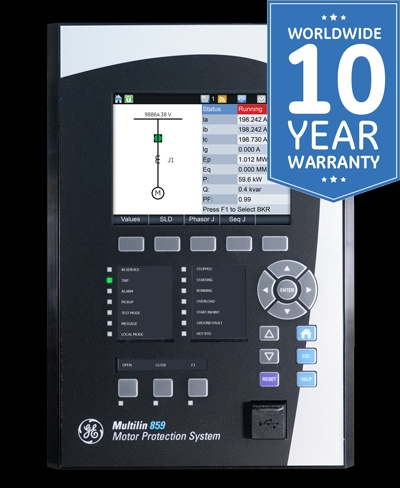
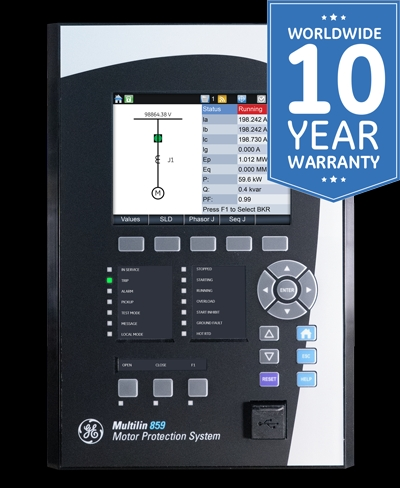
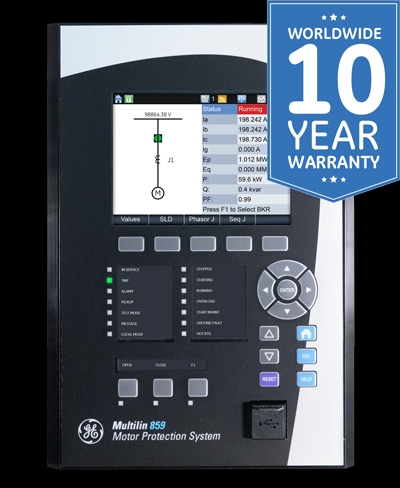
GE Multilin 859 Relay: A Deep Dive into the Ultimate Motor Management System
In the complex and demanding world of industrial operations, the protection and management of critical assets like high-voltage motors are non-negotiable. Motor failure can lead to catastrophic downtime, costly repairs, and significant production losses. The GE Multilin 859 Motor Management Relay stands as a technological sentinel, designed specifically to safeguard, control, and monitor these vital workhorses of industry. The specific model 859-BO-P0-NN-NN-H-A-N-C-N-N-M-B-B-F-B-1E-C-N-B-N represents a highly customized configuration of this powerful device, tailored for a specific set of application requirements. This comprehensive overview will explore the capabilities of this relay, decode its extensive model number, and highlight why it is a cornerstone of modern industrial protection schemes.
Understanding the 859 Relay: More Than Just Protection
The GE Multilin 859 is not merely a protective relay; it is a complete motor management system. It consolidates the functions of multiple discrete devices—including overload relays, phase monitors, ground fault detectors, and control elements—into a single, intelligent unit. This integration simplifies panel design, reduces wiring, and provides a unified source of critical motor data.
At its core, the 859 is built to provide comprehensive protection against a wide array of potential fault conditions that can damage a motor or disrupt a process, including:
-
Thermal Overload Protection: Using advanced thermal model tracking, it accurately simulates the motor's heating and cooling characteristics, preventing damage from overload conditions while allowing for maximum motor utilization.
-
Short Circuit and Phase Fault Protection: It offers instantaneous and time-delayed overcurrent elements to quickly clear destructive electrical faults.
-
Ground Fault Protection: Sensitively detects insulation failures and ground faults, which are critical for personnel safety and equipment integrity.
-
Advanced Mechanical Fault Detection: It can be configured to monitor for jams, undercurrent (loss of load), and bearing wear, providing early warnings before catastrophic mechanical failure occurs.
Decoding the Model Number: A Configuration Breakdown
The lengthy model number is essentially a detailed checklist of the relay's hardware and software features. Each segment, separated by a hyphen, specifies a particular option. Let's break down the key components of 859-BO-P0-NN-NN-H-A-N-C-N-N-M-B-B-F-B-1E-C-N-B-N:
-
859: The base model, identifying it as a Motor Management Relay.
-
BO: This typically specifies the power supply and input voltage. "BO" often indicates a specific wide-range AC/DC supply, ensuring compatibility with various control power systems.
-
P0: This denotes the current transformer (CT) input rating. "P0" usually signifies a 5A primary CT input, which is a standard for many industrial motor applications.
-
NN-NN: These positions often relate to communication protocols. "NN" typically means no optional communication modules are installed in those slots. This suggests the relay may rely on its standard communication (like a base RS485 Modbus) or that communication is handled differently in this configuration.
-
H: This code defines the output relay configuration. "H" specifies a particular arrangement of Form-C (changeover) contacts for tripping, alarming, and control functions.
-
A: This indicates the human-machine interface (HMI). "A" usually refers to the standard, full-featured keypad and LCD display, allowing for local configuration, control, and data viewing.
-
N: This specifies no additional analog outputs.
-
C: This defines the VT (Voltage Transformer) input. "C" indicates a specific voltage input range, allowing the relay to monitor bus voltage for advanced functions like under/overvoltage protection and power monitoring.
-
N-N-M-B-B-F-B-1E-C-N-B-N: The remaining codes specify a host of other features, including:
-
The inclusion of specific I/O modules (M, B, B).
-
DC Board and Surge Suppression ratings (F, B).
-
Software Featuresets (1E), which unlock advanced protection and metering functions.
-
Agency Approvals (C, N, B, N), such as UL, CE, or ATEX for specific hazardous environment certifications.
This detailed coding system ensures that every GE Multilin 859 relay is precisely configured for its intended duty, eliminating guesswork and ensuring all required features are present.
Key Features and System Benefits
1. Advanced Monitoring and Diagnostics:
The 859 provides a wealth of real-time data, including currents, voltages, power, energy, and thermal capacity used. This information is crucial for predictive maintenance, allowing operators to identify trends and address issues before they lead to failure. The relay records last fault and start profile data, making root cause analysis swift and accurate following a trip event.
2. Robust Control Capabilities:
It offers flexible control logic, supporting up to four configurable setpoints and multiple start profiles (across the full 859 series). This allows for complex control sequences, such as coordinating with lubrication pumps or pre-start ventilation systems.
3. Communication and Integration:
Even with "NN" in some communication slots, the base relay supports industry-standard protocols like Modbus RTU over RS485. This enables seamless integration into SCADA systems, DCS, and Plant Asset Management software, providing plant-wide visibility into motor health and performance.
4. User-Friendly Interface:
The intuitive local HMI with its clear LCD display and navigational keypad allows for easy on-site configuration and troubleshooting without the need for a laptop or specialized software.
Typical Applications
The versatility of the GE Multilin 859 makes it suitable for a vast range of demanding applications:
-
Oil & Gas: Protecting critical pumps, compressors, and fans on offshore platforms and in refineries.
-
Mining: Managing high-inertia loads like crushers, conveyors, and ball mills.
-
Water/Wastewater: Safeguarding pumps and aeration blowers in treatment plants.
-
Power Generation: Used for boiler feed pumps, induced draft fans, and other auxiliary motors.
-
Heavy Industry: Protecting motors in metal, cement, and pulp & paper production.
Conclusion: The Intelligent Choice for Motor Reliability
The GE Relay 859-BO-P0-NN-NN-H-A-N-C-N-N-M-B-B-F-B-1E-C-N-B-N is more than a component; it is a strategic investment in operational reliability and efficiency. By providing unparalleled protection, detailed diagnostics, and flexible control, it extends motor life, minimizes unplanned downtime, and enhances overall plant safety. For engineers and asset managers tasked with protecting high-value motor-driven equipment, specifying this precisely configured GE Multilin 859 relay ensures performance, peace of mind, and a significant return on investment over the asset's entire lifecycle. It represents the gold standard in intelligent motor management for the modern industrial landscape.