
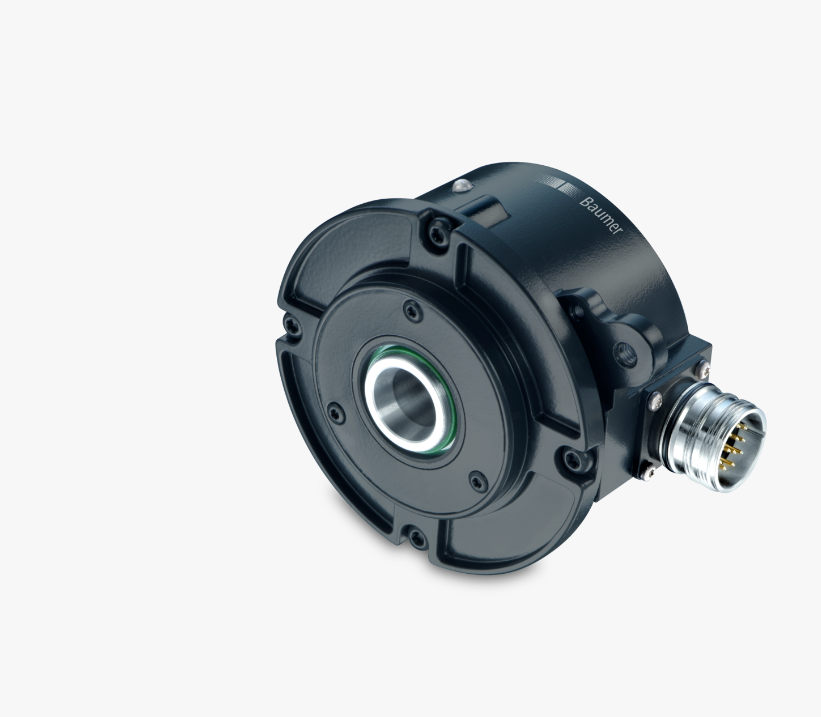
The Baumer HOG10 DN 2500 TTL encoder stands as one of the most refined incremental rotary encoders designed for demanding industrial motion-control systems. Within the HOG10 family, this 2500-PPR variant combines high resolution, stable TTL output performance, and exceptional mechanical strength, giving engineers a dependable tool for achieving precise, accurate, and consistent rotary feedback. Because industrial automation environments continue to pursue higher performance standards, components like the HOG10 DN 2500 TTL increasingly become essential for motor control, positioning workflows, and speed regulation.
The encoder delivers 2500 pulses per revolution, a value that places it among higher-resolution options in its class. This level of detail enables engineers to build tight control loops, integrate advanced servo behavior, and regulate rotational movements with smoothness and accuracy. The incremental pulse train includes A and B channels, each phase-shifted to indicate direction. The index channel provides a unique reference pulse once per revolution, enabling homing, synchronizing, and precise repeatable starting points. Combined, these signals help ensure responsive and predictable control, even when machinery operates at high speeds or requires delicate movements.
The encoder’s TTL output plays an essential role in its performance. TTL logic levels allow robust digital signal integrity, even when cabling spans long distances or when system components generate electrical noise. Because industrial facilities often contain motors, drives, switching devices, and variable-frequency inverters, noise immunity becomes critical. The HOG10 DN 2500 TTL maintains a clear, square-wave output that retains crisp edges and consistent timing. Controllers and drive systems benefit from these clean signals because precise timing helps maintain stable control routines and reduces jitter in feedback loops.
Mechanical durability remains one of the defining strengths of the HOG10 series. The HOG10 DN 2500 TTL uses a solid shaft and a precise DN interface that aligns with industrial mechanical standards. The 16H7 fit ensures a secure, correctly centered connection between the encoder shaft and the motor shaft. This close-tolerance design minimizes mechanical runout and reduces the chances of vibration-induced errors. The encoder housing withstands physical shock, temperature variations, dust exposure, and lubricant residue, all of which often appear in industrial settings. This protective design shields the optical scanning system inside the encoder, ensuring long-term reliability.
Internally, the encoder uses high-quality optics and advanced LED-based signal generation. The optical disk includes extremely fine markings, which allow the device to generate its high-resolution 2500-pulse output. Because the scanning process relies on precise transitions between light and shadow, Baumer's optical components ensure stable performance throughout the encoder’s entire operational lifetime. The electronics maintain constant illumination and consistent pulse structure, even as temperature or workload conditions shift. The result is predictable, repeatable signal output that supports precision-driven motion-control tasks.
Although the HOG10 DN 2500 TTL includes advanced engineering, installation remains straightforward. The mechanical design fits compact spaces, and the mounting holes align with standard industrial layouts. The solid-shaft configuration allows direct coupling or flexible coupling methods, depending on system preferences. Because Baumer supports a range of cable outputs and connector styles, the encoder can adapt to different installation requirements, control cabinet distances, or integration frameworks. This installation flexibility makes the encoder a practical choice for both system upgrades and new equipment builds.
One of the defining advantages of the HOG10 DN 2500 TTL lies in its performance consistency across operational scenarios. In high-speed applications such as conveyor belts, automated packaging, high-RPM motors, or printing equipment, the encoder consistently generates accurate pulse trains without distortion from centrifugal forces or rapid speed changes. Conversely, in low-speed or intermittent-motion systems like indexing tables, positioning arms, or robotic mechanisms, the high 2500-pulse resolution supports detailed micro-movement analysis and precise control at fine granularity. This wide operating versatility allows automation engineers to rely on one encoder series across multiple system types.
The encoder's thermal stability further supports industrial reliability. Production environments often involve varying temperatures due to equipment heating, high-power motor operation, or environmental factors. The HOG10 DN 2500 TTL withstands these variations without drift or performance degradation. Thermal-optimized components ensure that the optical disk and sensor system maintain accurate alignment, while the electronics adjust accordingly to preserve stable output amplitude and duty cycle. This level of temperature tolerance makes the encoder usable in applications where lesser components may fail or deliver inconsistent performance.
Vibration resistance also contributes to long-term reliability. Industrial machines often generate sustained vibration during operation, especially in metal processing, pressing, grinding, and material-handling systems. The Baumer HOG10 DN 2500 TTL incorporates bearings and an internal mechanical structure designed to handle vibration without allowing signal fluctuation or optical misalignment. These design characteristics reduce the risk of unexpected stops, false pulses, and control irregularities caused by mechanical disturbances.
In environments where dust, oil mist, or humidity present challenges, the encoder’s sealed housing protects its internal components. Contaminants that commonly degrade optical encoders do not affect the HOG10 DN 2500 TTL as easily, allowing continuous operation for long periods without maintenance. When maintenance does become necessary, the device’s accessible design and standardized connectors minimize downtime. Technicians can replace units quickly, enabling smooth maintenance routines that support operational continuity in factories where productivity holds critical importance.
Baumer's HOG10 series, including the DN 2500 TTL variant, finds widespread use in industrial sectors such as:
• precision machining and CNC systems
• robotics and automated handling systems
• metal forming, rolling, and cutting equipment
• printing and packaging machinery
• material transport and conveyor automation
• power generation and turbine auxiliary equipment
• pump systems, compressors, and heavy motors
In each of these scenarios, the encoder provides accurate feedback critical for both speed and position loops. Because automation increasingly relies on real-time data to maintain efficiency and reduce waste, reliable encoders support productivity, safety, and process stability.
The HOG10 DN 2500 TTL offers excellent performance even when control systems require rapid acceleration and deceleration cycles. Because the TTL signal retains edge clarity regardless of the frequency, controllers can interpret speed changes immediately, allowing finely tuned dynamic behavior. This responsiveness benefits automation cells where motion must synchronize between axes, such as robotic manipulators, high-precision cutters, and multi-axis conveyor lines.
Additionally, the encoder’s high resolution plays a central role in modern digital automation. Today’s servo drives and PLCs often include advanced processing capabilities that take advantage of high-resolution feedback to perform smooth interpolation, energy-efficient motion, and predictive control strategies. By supplying 2500 pulses per revolution, the encoder ensures that these advanced algorithms receive highly accurate feedback data, unlocking the full potential of the control system.
In summary, the Baumer HOG10 DN 2500 TTL offers:
• high-resolution 2500-pulse incremental output
• TTL logic for stable, noise-resistant digital signals
• rugged mechanical and thermal durability
• stable operation across high-speed and low-speed scenarios
• easy installation and broad compatibility
• robust performance in harsh industrial environments
• precise control feedback for advanced automation systems
By combining strong engineering with high-quality optical components, the HOG10 DN 2500 TTL becomes a vital feedback element in modern industrial automation. Its reliability, precision, and robustness support efficient production, predictable machine behavior, and long-term operational stability across a diverse range of industries.

